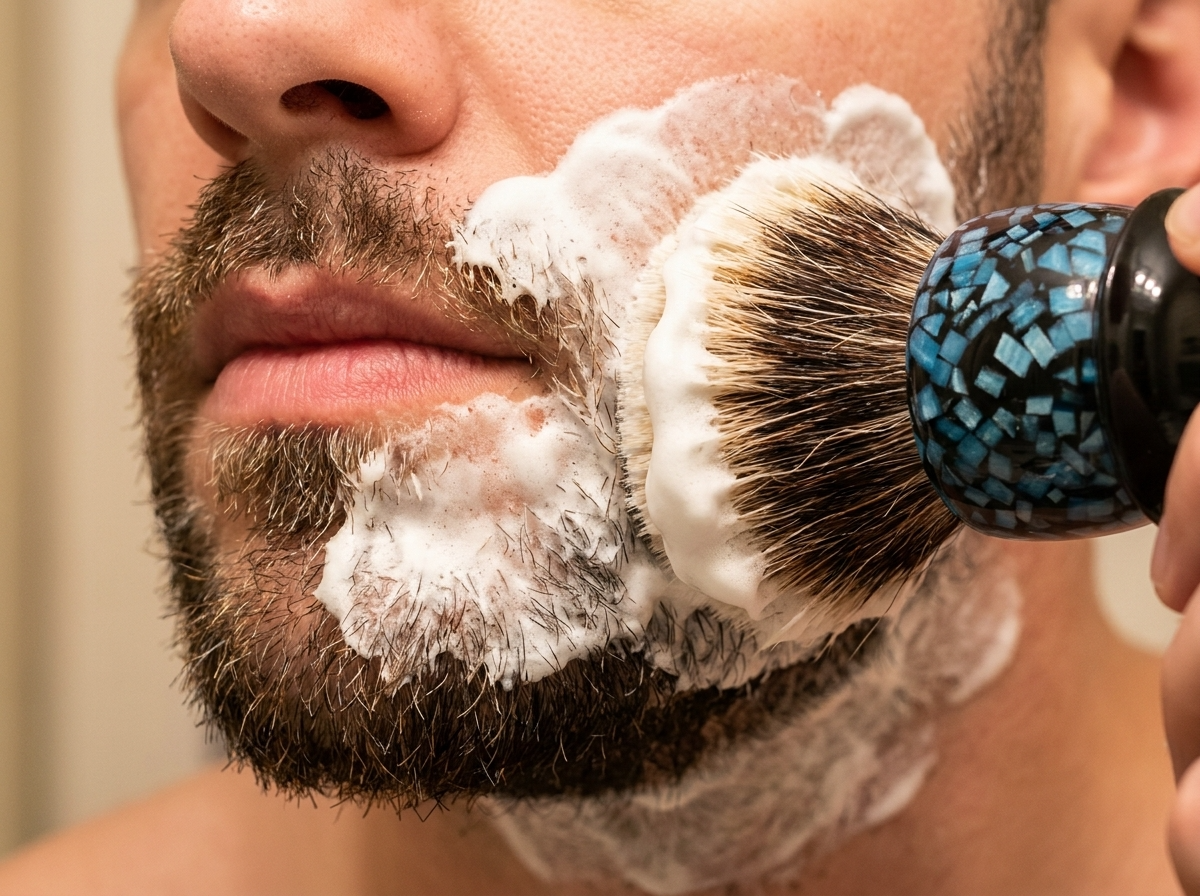
Article: 28mm vs 26mm Shaving Brush Knot: Does Size Actually Matter?
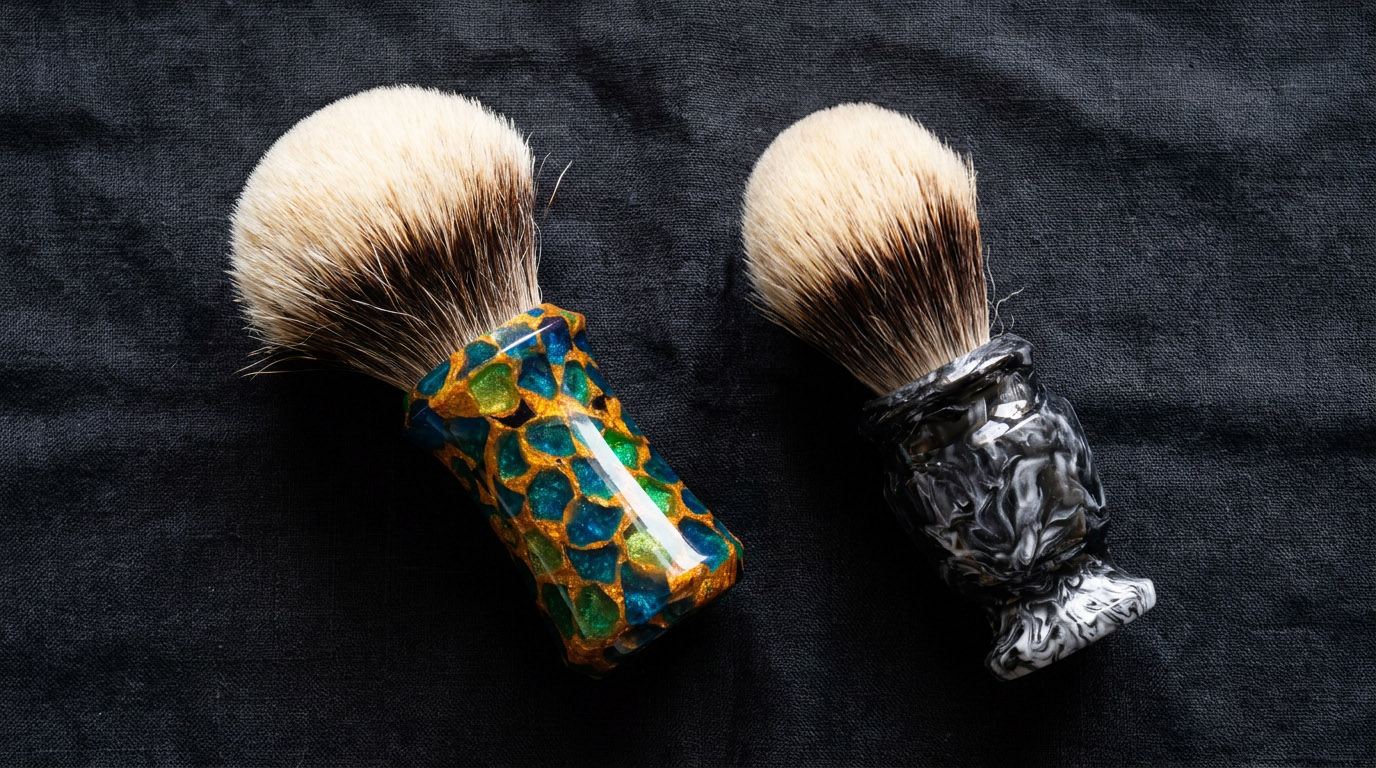
28mm vs 26mm Shaving Brush Knot: Does Size Actually Matter?
Why Knot Diameter Matters More Than You'd Expect
The diameter of a knot isn't just a measurement of width, but it determines how much hair is packed into the bundle.
Hair in a two-band badger knot is tied in a cylindrical bundle before being glued and set into the handle. A larger diameter means more hairs in that bundle, not just a proportionally wider shape. The relationship between diameter and hair count is roughly exponential, not linear.
The difference in hair volume between a 26mm and a 28mm knot is substantial: enough to change how the brush feels in your hand, how it interacts with soap, and how it performs across your face.

The 28mm Knot: What to Expect
A 28mm knot is the standard choice for most wet shavers, and there's a reason it dominates, as it strikes the balance between hair volume, lather capacity, and face coverage that works for the widest range of techniques and face shapes.
Lather capacity is the most immediate difference you'll notice. A 28mm knot holds more soap and water in its hair bundle. If you face lather, you have more working margin, the brush generates and retains lather throughout the pass without needing to reload. If you bowl lather, loading time is slightly shorter.
Coverage is broader: one stroke of a 28mm fan across your cheek covers more surface. For shavers with larger faces, heavier beard coverage, or those who prioritize speed in their morning routine, this matters practically.
Visual presence is also simply greater. A 28mm knot on the right handle has a presence, a weight and authority that a 26mm doesn't quite match. For many shavers, this is part of the appeal of an artisan brush.
The trade-off: the 28mm is slightly less precise in tight areas: under the nose, along the jawline near the ears, around the chin. For most shavers this is a non-issue. For those who shave daily and value control in those zones, it's worth noting.
The 26mm Knot: What to Expect
The 26mm is a deliberate choice, not a compromise. Shavers who select it typically know exactly what they want.
Agility is the primary advantage. A 26mm knot navigates tighter contours more naturally. Under the nose, along the philtrum, around a goatee line; the smaller footprint gives you more control in confined areas.
Lightness is the second factor. A 26mm knot combined with a lighter handle creates a brush with noticeably less overall weight and mass. Some shavers prefer this, particularly those who do longer multi-pass shaves and hold the brush for extended periods.
Density feel is different too. With fewer hairs and a smaller bundle, the 26mm can feel somewhat firmer relative to its size.
The trade-off: smaller lather reserve, less coverage per stroke, and visually less imposing on wider handles. If you buy a 26mm knot and put it in a handle designed for 28mm, it will look undersized and feel lost.
What the Numbers Show
Looking at Leonidam order data, the preference is clear: the ratio of 28mm to 26mm orders is approximately 7 to 3.
Seven out of ten customers configure their brush with a 28mm knot. Three out of ten choose 26mm.
The 26mm customers are not making a lesser choice, they're making a specific one. The majority of them have owned brushes before, know the difference, and are choosing smaller deliberately: for a second brush, for a travel companion, for a particular handle design, or for a specific shaving technique.
If you're buying your first Leonidam brush and you're uncertain: start with 28mm.
Common Scenarios and What Makes Sense
You shave your full face daily with no facial hair: 28mm. Broader coverage, more lather capacity, suits any technique.
You maintain a beard or goatee and need precision at the edges: 26mm. The smaller footprint gives you control around defined lines.
This is your second brush and you want something different from a 28mm you already own: 26mm. You know what the larger size feels like. The smaller size will offer a genuinely different experience.
You prioritize aesthetics and want the brush to look substantial: 28mm. There's no comparison in terms of visual weight and presence.
You travel frequently and want a compact brush that fits in a kit: 26mm. Smaller diameter, paired with a shorter handle, creates a brush that takes up considerably less space.
Summary
| 28mm | 26mm | |
|---|---|---|
| Hair volume | More | Less |
| Lather capacity | Higher | Lower |
| Coverage per stroke | Wider | Narrower |
| Precision | Lower | Higher |
| Best for | Most face shapes, most techniques | Beard edges, smaller faces, second brush |
| Most popular at Leonidam | Yes (70%) | No (30%) |
Both sizes are available across the Leonidam on-demand collection. If the model you want is configured with a specific diameter, that choice was made intentionally, but custom configurations are always open.
Leonidam shaving brushes are handmade in Treviso, Italy in batches of approximately 10 every 15 days.